- Today
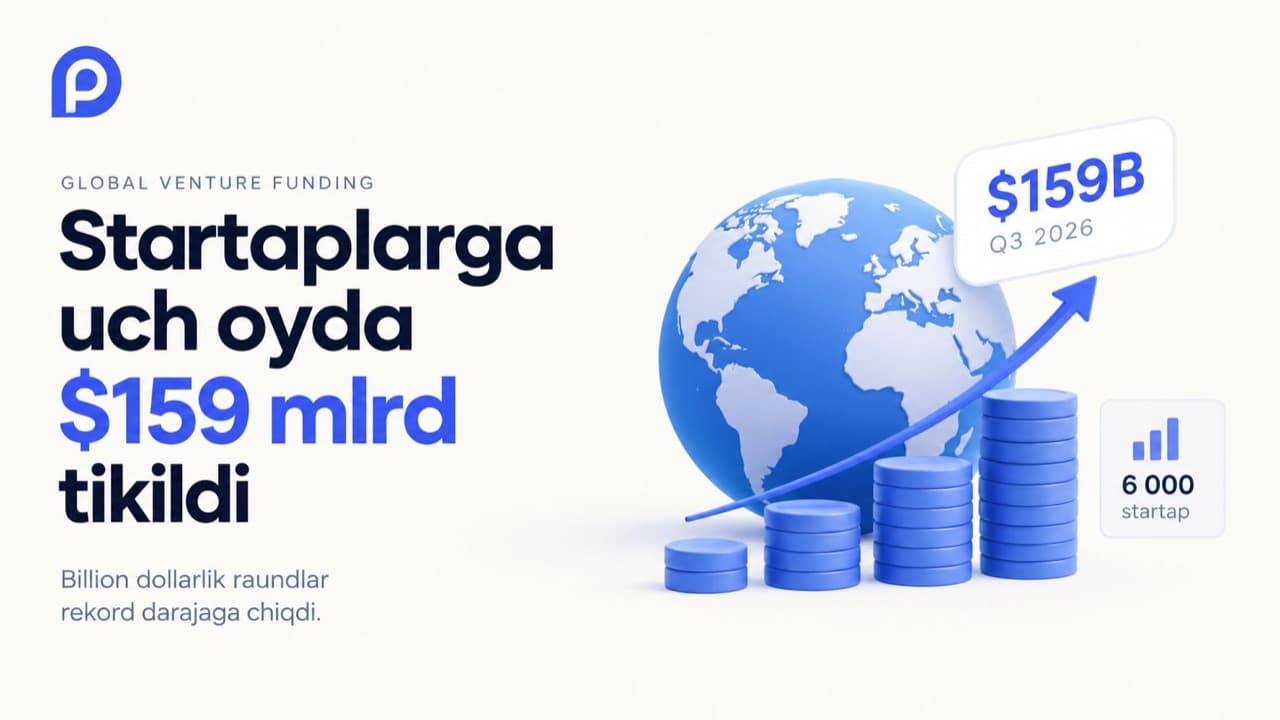
Global venture investments reached $159 billion in Q3 2026
Global startups raised $159 billion in venture funding during the third quarter of 2026, according to Crunchbase data. Nearly 6,000 startups received funding worldwide between July and September. However, the most notable figure was not the overall funding tot
- Sunday 4 October
Kazakhstan’s startup market is growing. The next challenge is global expansion
Kazakhstan’s startup ecosystem has expanded rapidly in recent years. According to the 2026 Kazakhstan Startup Landscape report, the RISE database includes more than 1,500 startups and technology companies in Kazakhstan, over 203 venture-backed companies, and i
World Bank approves $75 million to scale high-tech startups in Kazakhstan
The World Bank has approved a $75 million loan to support the development of high-tech startups in Kazakhstan, create new jobs, and attract private investment into the country’s technology sector. On September 30, the World Bank’s Board of Executive Directors

AI startups and No-Code tools: Building a startup without coding
Launching a tech startup previously required significant funding and a team of software engineers. Today, modern AI and No-Code technologies allow non-technical founders to build functional startup MVPs within days. 1. Popular No-Code and AI ecosystem Category

What is scalability? A guide to scaling and international expansion
The defining characteristic that distinguishes a startup from a traditional business is scalability. Scalability is the capacity to grow revenue exponentially while incurring only incremental operational costs. 1. The risk of premature scaling According to res

What is a post-mortem analysis? Learning from failure
In medicine, “post-mortem” refers to an autopsy conducted to determine the cause of death. In startup culture, a post-mortem is a blameless evaluation performed after a project failure or crisis to understand what went wrong and prevent recurrence. 1. 5 Steps

Why do 90% of startups fail? Analysis of the top 10 mistakes
Global startup statistics show that approximately 90% of new ventures fail. Why do promising ideas with talented teams and initial funding shut down? Based on data from CB Insights, we analyze the top 10 root causes. 1. Top 10 reasons startups fail (CB Insight

How to register a startup in Uzbekistan?
Uzbekistan has developed an attractive legal and tax regime for technology companies. By obtaining IT Park residency, tech startups receive broad tax exemptions. 1. Key tax benefits for IT Park residents (Guaranteed until 2040) Under Presidential Resolution No

What are SAFE agreements and convertible notes? Structuring investor deals
Determining a startup’s exact valuation during early stages (Pre-seed and Seed) is notoriously difficult. To avoid spending months negotiating valuation, founders and investors use convertible investment instruments. The most widely adopted standards are SAFE

What are vesting and cliff? Splitting equity among co-founders
A common mistake when founding a startup is granting 100% of the equity to co-founders upfront on day one. For example, if two co-founders split equity 50/50 and one departs after 3 months, they retain 50% of the venture. To prevent this, standard startup prac

What is bootstrapping? Growing a startup without external capital
Not every startup requires venture capital to achieve scale. Scaling a company using only personal savings and customer-generated revenue without institutional investors is called “Bootstrapping.” To build an MVP cost-effectively while bootstrapping, read our

Burn rate and runway: Managing startup finances correctly
The primary and most visible cause of startup failure is running out of cash. A founder must monitor precise monthly cash outflows (burn rate) and calculate remaining operational lifespan (runway). To learn how to extend your runway through sustainable self-fu

What is unit economics? Guide to calculating LTV and CAC
Many startups experience increasing financial losses as their sales volume grows. The underlying cause is often poor unit economics. If you lose money on a single unit or customer, scaling sales tenfold simply scales your losses tenfold. When unit economics ar

What are B2B, B2C and SaaS? Analysis of core business models
At least half of a startup’s potential success relies on its chosen business model—the structural methodology of converting created value into revenue (monetization). Selling identical software to enterprise clients (B2B) versus individual consumers (B2C) dema

What is the difference between an accelerator and an incubator? Which suits your venture best?
Early in their entrepreneurial journey, many inexperienced founders use the terms “accelerator” and “incubator” interchangeably. While both entities exist to support and nurture startup growth, they are fundamentally designed for completely different stages of

Cap table and valuation: Startup valuation and equity distribution
During a startup’s fundraising journey, founders must navigate two critical financial and legal concepts: the valuation of the company and the Capitalization Table (Cap Table). Misunderstanding these concepts or mismanaging equity allocation can lead to founde

What is a pitch deck? Creating a presentation that attracts investors
Investors review dozens, sometimes hundreds, of startup pitch decks every day. According to research by DocSend, an investor spends an average of 2 minutes and 42 seconds evaluating a single pitch deck. Consequently, your presentation must be concise, visually

What is the difference between a venture capital fund and an angel investor?
When searching for startup investment, founders frequently encounter the terms Angel investor and Venture Capital fund . While both provide capital to growing startups, their operating mechanics, risk tolerances, and expectations differ significantly. Read our

Investment stages: Pre-seed, Seed. Series A, B, C
As startups evolve from an initial concept into global giants, they progress through a multi-tiered funding chain. Each investment stage aligns with specific objectives, risk profiles, and product readiness levels. In this guide, we break down all major stages

What is a startup ecosystem? Startup environment in Uzbekistan
No startup can thrive on an isolated island. Behind every successful project stands a robust ecosystem—a network of accelerators, investors, government support, universities, and experienced mentors. In recent years, Uzbekistan has emerged as one of the fastes